When you think of gaming’s greatest achievements, A Link to the Past deserves a spot at the table. Released in 1991 for the Super Nintendo, this game didn’t just define an era, it fundamentally shaped how we understand action-adventure games. Whether you’re a veteran who’s memorized every secret or a newcomer curious about why this SNES classic still captivates gamers three decades later, this guide covers everything you need to know about The Legend of Zelda: A Link to the Past, from its revolutionary gameplay to its enduring legacy in the gaming industry.
Key Takeaways
- A Link to the Past revolutionized action-adventure games by perfecting the dungeon design template that influenced the entire Zelda franchise and modern games like Elden Ring.
- The innovative Light World and Dark World mechanic doubled gameplay scope by offering two interconnected versions of Hyrule, each with unique challenges and environmental puzzles.
- Zelda Link to the Past’s combat system prioritizes tactical, deliberate swordplay with thoughtful equipment management rather than complex combos, rewarding patience and observation.
- The game trusts players to discover secrets through environmental storytelling and exploration, with no quest markers or guides forcing genuine engagement with Hyrule.
- Nintendo Switch Online provides the most convenient way to experience this SNES classic today, with near-perfect emulation and no input lag compared to original cartridges.
- Nearly 35 years after its 1991 release, A Link to the Past remains essential gaming because its design principles—environmental storytelling, mechanical depth, and player respect—still matter more than modern graphical fidelity.
Game Overview and Historical Significance
Original Release and Platform History
A Link to the Past launched on November 21, 1991, exclusively on the Super Nintendo Entertainment System (SNES). This wasn’t Nintendo’s first crack at a home console Zelda game, the original The Legend of Zelda hit the NES in 1986, but A Link to the Past arrived at exactly the right moment. The Super Nintendo was still ramping up its library, and this action-adventure masterpiece became one of the system’s defining titles.
The game was later ported to the Game Boy Advance in 2002, introducing it to a handheld audience. More recently, Nintendo re-released it via the Virtual Console on Wii and Wii U, and it’s available on Nintendo Switch Online for modern players. The SNES version remains the purest experience, but the GBA port added the bonus dungeon “Palace of the Four Sword,” giving it unique appeal for collectors and completionists.
Development was handled by Nintendo’s legendary team, with producer Shigeru Miyamoto and director Kazuaki Morita guiding the vision. The game pushed the SNES hardware harder than most titles at the time, delivering a sprawling world with multiple dungeons, intricate puzzles, and combat that felt responsive and tactical.
Why This Game Changed Everything
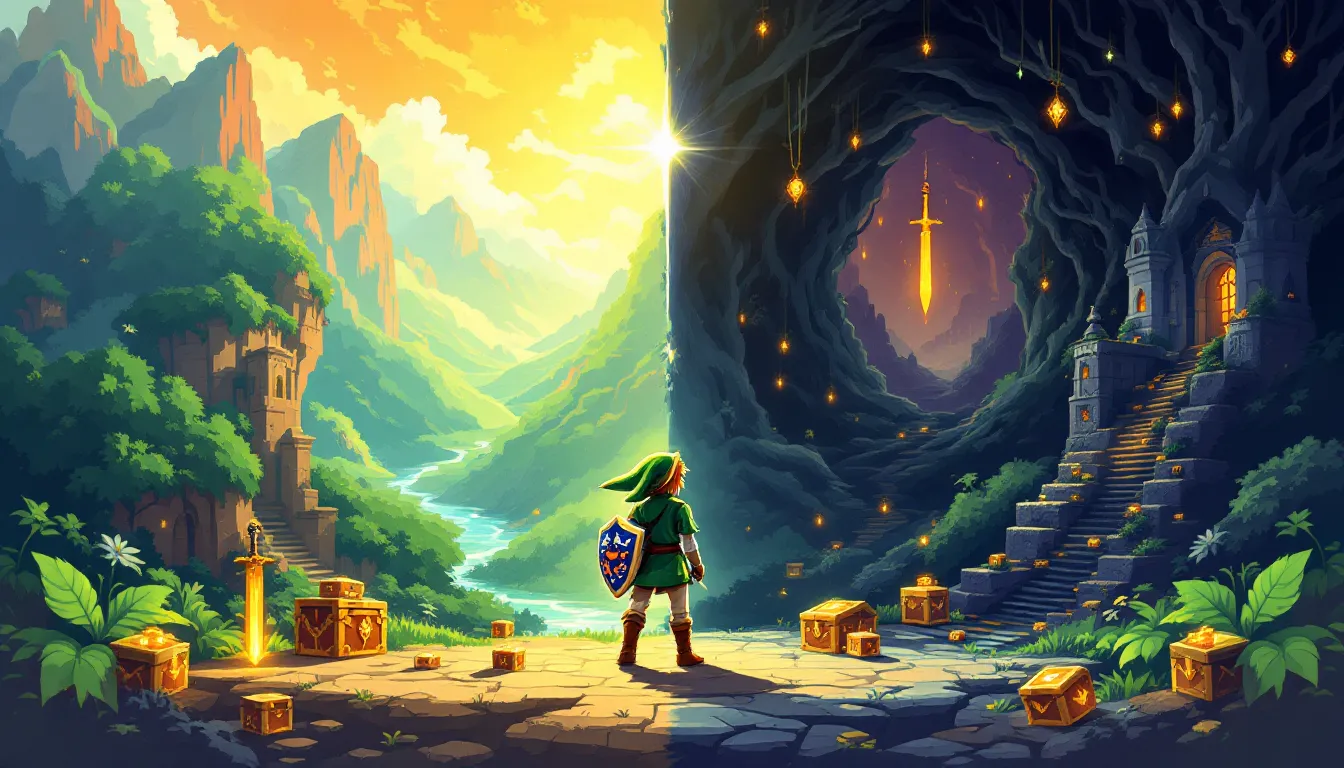
Before A Link to the Past, action-adventure games were still finding their identity. The original Zelda proved the formula could work, but A Link to the Past perfected it. The game introduced the Light World and Dark World mechanic, a narrative and mechanical innovation that doubled the gameplay scope. Players didn’t just explore Hyrule: they uncovered two interconnected versions of the same world, each with unique challenges and secrets.
The dungeon design in A Link to the Past became the template for the entire franchise. Each dungeon taught players a core mechanic through carefully paced encounters, then asked them to master that mechanic in increasingly complex puzzles. This philosophy didn’t just work, it became industry standard. Games like Ocarina of Time and Breath of the Wild owe their structural DNA to this SNES classic.
More broadly, A Link to the Past proved that action-adventure games could rival RPGs in scope and depth while maintaining tight, intuitive controls. It balanced exploration, combat, puzzle-solving, and storytelling in a way that felt effortless to players but required painstaking design work. That balance is harder to achieve than it sounds, and few games have matched it since.
Story, Setting, and Characters
The Hero of Hyrule: Understanding Link’s Journey
Link is silent, but his journey speaks volumes. In A Link to the Past, you play as a young hero who awakens with no clear memory of how he got there. The narrative unfolds as you progress, revealing that Agahnim, a dark sorcerer, has imprisoned Princess Zelda and begun draining the life force from Hyrule’s population.
Unlike later Zelda games that dive deep into character backstories and introspection, A Link to the Past keeps Link’s personality simple: he’s the everyman hero, defined by his actions rather than his words. This simplicity is actually brilliant game design. Players project themselves onto Link because the character isn’t overwritten with dialogue or personality quirks. You’re not playing as Link, you’re being Link.
The real character arc comes from the world around you. NPCs hint at a larger conflict. You’ll encounter Sahasrahla, an elder who guides you: the mysterious Aginah, who helps you early on: and eventually, you’ll learn that Link himself is connected to a legacy of heroism stretching back generations. The game trusts players to piece together the narrative through exploration and NPC dialogue rather than cutscenes.
Light World vs. Dark World: A Narrative Divided
The dual-world structure is A Link to the Past‘s greatest narrative innovation. The Light World represents Hyrule as it was, green, peaceful, but under siege by Agahnim’s sorcery. The Dark World (originally accessible only after obtaining the Pendant of Courage, the Pendant of Wisdom, and the Pendant of Power) is a twisted, corrupted mirror where everything is darker, deadlier, and more dangerous.
Navigating between worlds isn’t just a mechanical gimmick: it’s thematically essential. Puzzles often require understanding how the two worlds relate to each other. A barrier in the Light World might have a passage in the Dark World, or vice versa. This creates a spatial puzzle-solving experience that feels unique even today.
The narrative payoff comes when you realize the Dark World’s true nature: it’s not a separate dimension but the true form of Hyrule itself, corrupted by Ganon’s evil. You’re not fighting to access another realm, you’re fighting to purify your own world. This twist, revealed gradually through exploration and dialogue, adds emotional weight to an already compelling journey. The duality also serves the game’s pacing: as you grow more powerful and collect key items, the Dark World becomes increasingly explorable, creating a natural sense of progression.
Core Gameplay Mechanics and Controls
Combat and Equipment System
Combat in A Link to the Past is deliberate and reward-based. Link starts with nothing and must earn his arsenal through progression. Your first sword, the Fighters Sword, is solid but slow. Later, you’ll find the Master Sword and eventually the Tempered Sword and Golden Sword, each offering increased damage and speed.
Equipment depth was rare in 1991. You can equip one sword, one shield, and one piece of armor at a time. Different shields offer varying defense and knockback resistance: the Deku Shield is light but fragile, while the Blue Shield and Red Shield provide better protection. Armor choices range from the simple Blue Tunic to the Red Tunic (which halves fire damage) and the powerful Gold Armor, which doubles your defense but takes up precious inventory space.
The combat loop itself is simple but satisfying. You slash with your sword, manage stamina (represented as charging time for spin attacks), and use your shield to block incoming damage. Against tougher enemies, you’ll need to time your attacks, dodge incoming projectiles, and position yourself strategically. There’s no dodge-rolling or complex combos, just honest, tactical swordplay that rewards patience and observation.
Items like bombs, arrows, and magic rods add tactical layers. The Fire Rod, Ice Rod, and Bombos Medallion feel distinct and are essential for both combat and puzzle-solving. Mana management matters: your magic regenerates slowly, so spamming spells isn’t viable. This forces you to choose your moment.
Puzzle-Solving and Dungeon Design
Dungeons are where A Link to the Past truly excels. Each dungeon introduces a core mechanic and gradually escalates its complexity. The Eastern Palace teaches you how to use the Bomb item: the Desert Palace focuses on the Hook Shot: the Swamp Palace revolves around water manipulation with the Hookshot and water-level changes.
Puzzles feel organic rather than arbitrarily difficult. You’re never stuck wondering what the designer intended: the environment gives you clues. A button in a locked room suggests you need to find another path. A gap you can’t currently cross hints that you’ll return with a new item. This design philosophy, taught through environmental storytelling rather than explicit instruction, became the gold standard.
Boss encounters follow the same philosophy. Most bosses have a clear weakness tied to the dungeon’s core item. Learning this weakness and exploiting it feels intuitive. You’re not memorizing a complex attack pattern: you’re using your puzzle-solving skills in combat form. This seamless blend of dungeon design and boss difficulty creates a natural difficulty curve.
Exploration and World Interaction
Hyrule is packed with secrets, but they’re always discoverable through experimentation. Bombing suspicious walls, pushing dark blocks, and talking to NPCs gradually reveal hidden caves, heart containers, and power-ups. The world rewards curiosity without demanding a guide.
There’s no quest log or objective marker. You navigate through dialogue, environmental clues, and your own notes. This forces genuine engagement with the world. When an NPC mentions a “dark cave in the mountains,” you have to actually explore and find it. This creates a sense of discovery that modern games with exhaustive UI overlays rarely achieve.
Interaction is mostly limited to talking to NPCs, cutting grass for rupees, and bombing walls, but the simplicity is elegant. You know what you can interact with because the game’s visual language is clear. This directness is crucial to the game’s approachability.
Dungeons: Walkthrough and Strategy Tips
Eastern Palace and Early-Game Dungeons
The Eastern Palace is your introduction to dungeon design. It’s small, straightforward, and teaches you the fundamentals. Your goal is to collect the Pendant of Courage, but first, you’ll navigate a series of rooms that introduce bombing mechanics, switch puzzles, and basic combat encounters.
Strategy tip: Bombs are your primary tool here. Suspicious walls are always worth bombing. The dungeon is designed so you’ll naturally progress if you experiment. There’s no way to softlock yourself, and the design respects player agency.
Before accessing the Eastern Palace, you’ll likely encounter the Forest Dungeon (in the Lost Woods) and possibly Hyrule Castle itself. Hyrule Castle isn’t a traditional dungeon but a story-driven gauntlet that teaches you how to navigate combat encounters while managing limited resources. Complete it, and you’ll rescue Princess Zelda, setting up the game’s core narrative.
After the Eastern Palace, you gain access to the Desert Palace (south of Hyrule) and the Fire Dungeon. The Desert Palace introduces the Hookshot, a grappling tool that opens up new navigation possibilities. The Fire Dungeon, nestled in Death Mountain, heavily features fire-based hazards and requires the Blue Tunic to survive certain areas. Both dungeons are significantly harder than the Eastern Palace, marking a clear difficulty spike.
Mid-Game Dungeons: Key Items and Power-Ups
Once you’ve conquered the Eastern Palace, the game opens up. The Swamp Palace and Ice Palace (accessible via Swamp Ruins and Ice Ruins in the Dark World) are where A Link to the Past truly showcases its design mastery.
The Swamp Palace revolves around water-level manipulation. You’ll use switches to raise and lower water, opening new paths and revealing secrets. The puzzles here require you to visualize how water flow affects the entire dungeon structure. It’s brilliant design that teaches spatial reasoning.
The Ice Palace is notoriously difficult. Slippery floor mechanics force you to plan your movements carefully. The dungeon is merciless if you’re not patient, but once you understand the rhythm, progression feels natural. This dungeon separates players who’ve mastered movement from those still learning. Newer players often cite this as the point where A Link to the Past stops being forgiving, which is intentional. The game gradually demands more skill.
Mid-game dungeons also introduce key items like the Power Glove (letting you lift heavy boulders) and the Icy Glove (allowing you to navigate frozen areas). These items permanently expand your capabilities and are essential for accessing late-game content.
Late-Game Dungeons and Boss Strategies
The Dark Palace, the Misery Mire, and the Turtle Rock are brutal. These dungeons assume mastery of all core mechanics and introduce new hazards specifically designed to punish carelessness.
Dark Palace is a navigation nightmare, it’s packed with pits and enemies, and mistakes are costly. Bring plenty of potions. Misery Mire features Misery Toad (a relatively straightforward boss) and introduces the Cane of Somaria, a magical tool that creates temporary blocks for puzzle-solving.
Turtle Rock is the ultimate test. The dungeon is massive, filled with laser-firing enemies, precise platforming segments, and complex multi-room puzzles. Boss-wise, it culminates in an encounter with the Trinexx, a three-headed hydra that requires you to exploit its elemental weaknesses (Ice Rod freezes its blue head, Fire Rod ignites the red head). This fight synthesizes everything you’ve learned.
Late-game strategy: Stock up on potions. Bring full magic reserves. Use the Magic Mirror to warp back to the Light World if you need to reset and regroup. These dungeons are designed to be challenging, and there’s no shame in taking breaks or looking up specific puzzle solutions. The journey matters more than the speed run.
Essential Items and Power-Ups
Sword, Shield, and Armor Options
Your melee arsenal defines your combat capability. The progression is clear: Fighters Sword → Master Sword → Tempered Sword → Golden Sword. Each upgrade roughly doubles your damage output. The Golden Sword is the ultimate reward, unlocked after collecting all Pendants and power-ups.
Shields are equally important. The Deku Shield is free but breaks after a few hits. The Blue Shield offers solid protection and is found relatively early. The Red Shield is a mid-game upgrade that provides better knockback resistance. The Mirror Shield (the strongest available) reduces damage further and has a subtle glow effect.
Armor choices affect your durability. The Blue Tunic is your starting point, functional but fragile. The Red Tunic halves fire damage, which is invaluable in the Fire Dungeon and when fighting fire-based enemies. The Blue Armor (sometimes called Gold Armor in different translations) doubles your defense, letting you survive two hits instead of one.
Strategy-wise, equip based on the challenge. Facing the Fire Dungeon? Red Tunic. Attempting a damage-heavy late-game gauntlet? Gold Armor. The system rewards thoughtful equipment management rather than simply maxing out stats.
Special Tools and Their Uses
Tools like the Hookshot, Bow, Bombs, and Magic Rods extend your tactical options. The Hookshot is fundamental, it lets you traverse gaps, pull yourself across chasms, and solve environmental puzzles. Master it early.
The Bow is your ranged option. Early on, you’ll use it mostly for distance attacks, but later, special arrows unlock new possibilities. Fire Arrows can ignite torches or damage certain enemies: Ice Arrows freeze enemies temporarily: Silver Arrows are the only weapon that damages Ganon in his final form.
Bombs are your utility tool. They damage enemies, destroy walls, and solve pressure-based puzzles. You can carry up to 50, and the game is generous with bomb drops from defeated enemies. The Bombos Medallion is a magical variant that creates an explosion, damaging all on-screen enemies.
Magic Rods include the Fire Rod, Ice Rod, and Somaria Rod. The Fire Rod is crucial for melting ice blocks and lighting torches. The Ice Rod is invaluable in hot environments and freezes enemies temporarily. The Somaria Rod creates temporary blocks for puzzle-solving and has niche combat uses. Each costs mana to use, so conservation matters.
The Pegasus Boots deserve special mention. This late-game find lets you dash, opening up movement-based puzzles and combat techniques. Equip them in your item slot and hold the button to charge a dash. Timing dashes correctly bypasses hazards and creates new combat openings.
Secrets, Collectibles, and Side Content
Hidden Heart Pieces and Power-Ups
A Link to the Past hides 24 heart pieces scattered across both worlds. Collecting four pieces grants one full heart container. Finding all 24 requires exploration, puzzle-solving, and often revisiting areas with newly acquired items.
Heart pieces reward curiosity. Some are hidden in treasure chests behind secret walls. Others are rewards for solving environmental puzzles or defeating specific enemies. A few are locked behind challenging combat encounters that are entirely optional. This variety keeps exploration fresh, you never know what you’ll find or how you’ll obtain it.
Magic containers are equally valuable. These increase your magic reservoir, letting you cast spells more frequently. Early-game magic is limited, but as you collect containers, you unlock more aggressive magical play.
Bottle-finding is another side quest. Bottles let you carry potions, which are lifesavers in tough dungeons. There are four bottles in the game, found in caves, behind secret walls, or from NPCs. Collecting all four maximizes your survival options.
Optional Bosses and Bonus Challenges
The Great Fairies scattered throughout Hyrule aren’t bosses but allies. Reaching them grants temporary stat boosts, the Blue Fairy increases your magic defense, the Red Fairy boosts your attack. These optional encounters reward exploration and add strategic depth to combat encounters.
Pig Ganon is an optional super-boss found in the Dark World’s pyramid. Defeating him requires the Hammer and careful positioning. He’s significantly harder than mandatory bosses and purely optional, serving as an ultimate end-game challenge for completionists.
The Piece of Heart challenges in caves sometimes require solving timed puzzles or surviving enemy gauntlets. These mini-challenges are entirely optional but provide genuine difficulty spikes for skilled players. Attempting them teaches advanced techniques like bomb-jumping and precise dashing.
There’s also the Ether and Bombos medallions, which are found in optional caves and dungeons. Unlike the Quake medallion (mandatory for progression), these are missable power-ups that reward thorough exploration. IGN’s guides on classic Zelda games provide detailed maps for players hunting every secret.
Modern Ports and Remakes: How to Play Today
SNES Classic and Virtual Console Versions
The SNES Classic Edition, released in 2017, bundled A Link to the Past with 20 other classics. This was the most accessible way to play the game for over a decade. The emulation is solid, controls are responsive, and the library around it (Super Metroid, Castlevania IV) makes it worth the investment if you’re into retro gaming.
The Virtual Console releases on Wii, Wii U, and 3DS offered emulated versions with varying quality. The Wii version is generally considered the best, solid emulation with comfortable controller layouts. The Wii U version works similarly. The 3DS version has a smaller screen, which impacts readability but works if you value portability.
All Virtual Console versions are now delisted as Nintendo cycles its digital offerings. If you own them, great. If not, you’ll need physical SNES cartridges or the SNES Classic Edition.
The original SNES cartridge remains the gold standard. Physical copies vary in price but are readily available on the secondhand market. Expect to pay $30–60 for a loose cartridge or $50–100+ for a complete-in-box copy with manual and box art. Condition significantly affects pricing.
Nintendo Switch Access and Performance
Nintendo Switch Online’s SNES library includes A Link to the Past, accessible via subscription. This is the most convenient modern option, no additional purchase needed beyond the subscription, instant access, and online save features.
Performance-wise, the Switch version is emulated but runs flawlessly. Load times are minimal, and the game scales well to the Switch’s 1080p docked or handheld 720p display. The emulation is nearly perfect, with accurate colors and no noticeable input lag.
One caveat: the Game Boy Advance version (if you can find it, which you mostly can’t since Nintendo delisted it from their official channels) includes the bonus Palace of the Four Sword dungeon, an additional late-game challenge with unique enemies and puzzles. This version is rarer and more expensive on the secondhand market but worth seeking out if you’re a completionist.
For new players, Nintendo Switch Online is the entry point. For enthusiasts, the SNES cartridge or SNES Classic Edition is ideal. Whichever version you choose, the core experience remains identical, this is A Link to the Past, unchanged and unchanged for good reason. Game Informer reviews of classic games often detail version differences worth considering before purchasing.
Legacy and Impact on the Gaming Industry
Influence on Future Zelda Games
A Link to the Past established the template every Zelda game would follow. The structure of collecting items, accessing new dungeons, and progressively gaining power is directly inherited by Ocarina of Time, Twilight Princess, Wind Waker, and beyond. Even Breath of the Wild, which broke formula conventions, respects the core design philosophy of dungeon-based progression and environmental puzzle-solving.
Specific mechanics rippled forward. The dual-world concept inspired Lorule in A Link Between Worlds (a spiritual successor released in 2013 for 3DS). The item-progression structure, where new tools unlock new areas, became standard. The boss-design philosophy of teaching players mechanics through dungeon design before testing mastery in boss fights remains unchanged.
Developers across the industry studied A Link to the Past. The Metroidvania genre, popularized by Super Metroid (released the same year), borrowed the gated-progression structure where items unlock new areas. Games like Hollow Knight and Dead Cells directly descend from this lineage. The influence extends beyond Zelda: modern action-adventure games from Uncharted to Elden Ring trace their design DNA back to the principles A Link to the Past established.
Cultural Recognition and Fan Community
Gaming’s cultural impact accelerated in the 1990s, and A Link to the Past was a centerpiece. It legitimized gaming as a medium by delivering mechanical depth, narrative intrigue, and artistic direction that rivaled any entertainment form. Critics praised it, it won numerous Game of the Year awards and was inducted into the Video Game Hall of Fame.
The fan community remains active. Speedrunners have optimized A Link to the Past to absurd degrees: the any% world record is under 1 hour 20 minutes. Randomizer communities have created ROM hacks that shuffle items and dungeon order, creating entirely new challenges. Mod creators have rebalanced difficulty, added new dungeons, and even translated the game into languages it never officially released in.
The game’s legacy extends to modern Nintendo. Elements of Hyrule Castle from A Link to the Past appear in Breath of the Wild’s overworld. The music, Koji Kondo’s iconic theme, has been remixed and reinterpreted hundreds of times. The game is referenced in countless media: it’s shorthand for “fantasy adventure” in gaming culture.
RPG Site’s coverage of classic RPGs and action games frequently highlights A Link to the Past when discussing foundational design, proving its influence spans decades. The game isn’t just beloved, it’s essential.
Conclusion
Nearly 35 years after its release, The Legend of Zelda: A Link to the Past remains essential gaming. It’s not the flashiest title, no voice acting, no sprawling open world, no modern conveniences. It’s also precisely because of this that it endures. The game respects player intelligence, trusts environmental storytelling over exposition, and proves that mechanical depth beats graphical fidelity.
Whether you’re revisiting it via Switch Online, hunting down a physical SNES cartridge, or discovering it for the first time, this Super Nintendo masterpiece offers something modern games increasingly struggle to deliver: a complete, polished experience that knows exactly what it is and executes flawlessly.
Start with the Eastern Palace, explore Hyrule at your own pace, collect the Pendants, and face Ganon. The journey is shorter than modern epics but infinitely more memorable. A Link to the Past didn’t just define a generation of gaming, it set the standard that still matters today.
About The Author