The initial fascination with AI-generated video is beginning to subside, replaced by a more pragmatic demand from the creative industry: how do we actually make money with this? For the first eighteen months of the generative boom, the focus remained largely on the “magic” of a single prompt. Creators spent hours chasing a single high-fidelity clip to post on social media for engagement. However, in a professional studio environment, engagement is a vanity metric if it cannot be converted into a repeatable, billable service.
The shift we are seeing now is from experimental creation to pipeline architecture. Production houses and independent editors are no longer looking for a standalone miracle tool; they are looking for a reliable AI Video Generator that can integrate into a broader post-production ecosystem. Success in 2024 and beyond isn’t about knowing the “best” prompt—it’s about knowing how to structure a workflow where AI serves as a modular component rather than a black box.
The Transition from One-Off Prompts to Scalable Assets
Most creators start their AI journey by treating the generator like a slot machine—pulling the lever with different phrases until something usable emerges. This is the antithesis of a profitable business model. In a commercial setting, time is the primary overhead. If an editor spends four hours trying to get a specific three-second clip, the cost of labor has already exceeded the value of the asset.
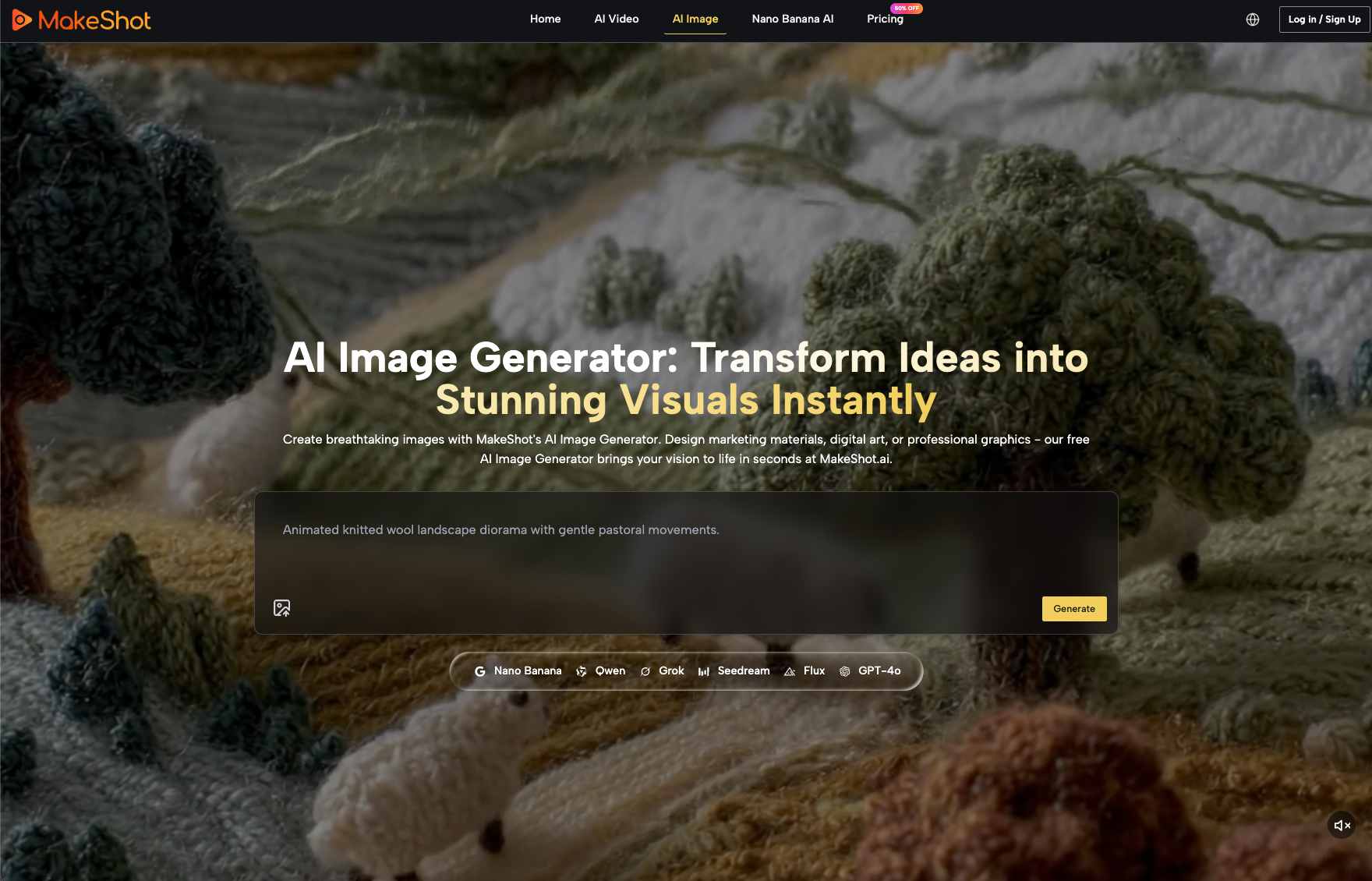
To move toward a scalable system, the focus must shift from the novelty of the clip to the consistency of the brand. This requires a transition from “prompting” to “asset management.” Professional creators are now using platforms like MakeShot to consolidate various high-end models—including Veo and Kling—into a single workspace. By centralizing these tools, a studio can maintain a visual “look book” across an entire campaign.
The goal is to create a library of repeatable assets. Instead of starting from scratch for every video, an operator builds a set of stylistic parameters—often beginning with a fixed set of image-to-video seeds—to ensure that every output feels like it belongs in the same universe. This structural approach is what allows a solo creator to compete with mid-sized agencies on volume without sacrificing the aesthetic integrity of the work.
Integrating an AI Video Generator into the Post-Production Stack
A common mistake in the current discourse is the idea that AI will “replace” the editor. In a professional workflow, the AI Video Generator is more accurately viewed as a sophisticated synthetic B-roll engine. It is a tool used to fill the gaps that would otherwise require expensive location scouting, licensing fees for high-end stock footage, or complex 3D modeling.
The technical hand-off is where the profit is actually realized. An experienced editor doesn’t just take an AI clip and upload it. They treat the AI output as raw footage. This involves:
- Up-resing and Sharpening: Using specialized plugins to remove temporal noise or flickering that often occurs in generative outputs.
- Layering and Compositing: Using AI-generated elements as overlays or background plates behind a green-screened subject.
By treating the generative tool as a source of “raw material,” the editor maintains creative control. It’s important to note an area of current uncertainty: we are not yet at a stage where AI can reliably handle complex, multi-subject interactions with perfect spatial awareness. If a script requires two people to shake hands while passing a specific object, traditional filming remains the more cost-effective choice. Recognizing these boundaries prevents a project from stalling in “prompt hell.”
Workflow Mapping: Bridging the Gap Between Concept and Client Delivery
Monetization depends on the speed of the feedback loop. In traditional production, a “pre-viz” (pre-visualization) phase can take days or weeks. Using a tool like Nano Banana within the MakeShot ecosystem allows for rapid prototyping. A creator can generate forty or fifty low-resolution “sketches” of a scene in the time it would take to draw a single storyboard frame.
This speed changes the client relationship. Instead of showing a client a mood board of existing images and saying “it will look kind of like this,” a creator can show a high-fidelity AI-generated draft. This reduces the risk of “creative drift”—where the client’s expectation and the final product diverge.
The most efficient workflow often begins with an image-to-video approach. By first generating a high-quality static image that defines the lighting, character, and composition, the creator provides the AI Video Generator with a concrete reference point. This results in much higher temporal consistency than text-to-video alone. For a creator, this means fewer “bad” generations and a faster path to a billable final export.
Cost-Efficiency and the Speed-to-Market Advantage
The “buyer-aware” perspective on AI video is rooted in the “cost per minute” of finished content. In performance marketing, where brands need to test twenty different variations of an ad to see which converts, traditional production is prohibitively expensive. This is where the AI-assisted pipeline shines.
By building a system around generative tools, a studio can offer a “high-volume asset delivery” model. Instead of a fixed fee for one commercial, they can offer a retainer for fifty unique social-first assets per month. The economics work because the marginal cost of creating the second, third, and tenth variation of a scene is significantly lower than the first.
However, we must reset expectations regarding “one-click” production. While the AI saves time on the visual generation, the human requirement for narrative pacing, sound design, and brand safety check remains constant. A studio that fails to account for the human-led QC (Quality Control) phase will eventually face client churn when “hallucinations”—like a character having six fingers or background architecture melting—make it into a final delivery.

Current Technical Limits and the Human-in-the-Loop Necessity
To speak with genuine authority on this tech, one must acknowledge its current failures. Temporal consistency in long-form narratives remains a massive hurdle. You cannot currently ask an AI Video Generator to maintain the exact facial features of a character across a three-minute short film without significant manual intervention or external “LoRA” (Low-Rank Adaptation) training.
Furthermore, nuanced emotional performances are still difficult to achieve. While AI can do “sad person looking at rain” quite well, it struggles with the subtle micro-expressions required for high-stakes drama. Editors must step in here, often using AI for the wide shots and “vibe” transitions, while relying on traditional footage or heavy manual editing for character-driven moments.
There is also a limitation in complex physics. Fluids, shattering glass, and intricate mechanical movements still frequently “break” in generative models. A professional operator knows when to stop trying to force the AI and when to switch back to traditional VFX or stock footage. This judgment is the difference between a project that is profitable and one that is a resource sink.
Building a Competitive Edge with Multi-Model Ecosystems
The long-term winners in the creator economy won’t be those who are loyal to a single model, but those who are masters of integration. The generative landscape is moving too fast for any single engine—be it Sora, Runway, or Kling—to hold the lead indefinitely.
By utilizing a platform like MakeShot, creators future-proof their operations. They gain the ability to pivot as models evolve. If Model A is better at cinematic landscapes but Model B excels at human movement, a unified workflow allows the editor to pull the best from both without fracturing their pipeline.
The monetization of AI video is ultimately about reclaiming the “middle ground” of production. It’s for the projects that have a budget too small for a Hollywood crew but a vision too large for basic stock clips. By architecting a system that treats an AI Video Generator as a high-speed production assistant, creators can deliver a level of visual sophistication that was previously gated behind million-dollar budgets. The “magic” is gone, and in its place is something much better: a viable, repeatable business.
About The Author